

Most adults carry a small glowing rectangle that quietly reshapes how they think, feel, pray, and relate to others. Our devices wake us, entertain us, inform us, and lull us to sleep. Ephesians 5:15–16 reminds us to “look carefully then how you walk, not as unwise but as wise, making the best use of the time.” The way we use technology is now one of the main places where that wisdom—or lack of it—shows up.
When Our Devices Quietly Shape Our Days
For many adults, the day begins and ends with a screen. Before we speak to anyone, we check messages. Instead of quiet before bed, we scroll. Studies and everyday experience suggest that constant digital interruptions erode our focus and make sustained attention—on God, on people, on anything—harder and harder.
This is not only a productivity issue; it is a spiritual one. Our phones disciple us, shaping what we notice, what we fear, what we desire, and how we spend our limited hours. If we do not pay attention, algorithms and alerts will decide for us what fills our mind, instead of God’s Word and God’s priorities.
The Bible never mentions smartphones, but it speaks clearly about our hearts, our time, and our self‑control. The question for a Christian adult is not “Do I own a phone?” but “Has my phone begun to own me?”

Is My Phone Ruling Me—or Serving Me?
Paul writes, “All things are lawful for me, but I will not be dominated by anything” (1 Corinthians 6:12). Digital tools are not inherently sinful. A Bible app and a gossip thread can live side by side on the same device. The question is: in practice, which one gets more of your attention and shapes more of your inner life?
Many adults feel a quiet pull they did not choose. A notification buzzes and they reach instinctively. A free minute appears and the thumb automatically opens a favorite app. Long before there is a conscious decision, a habit has already been formed. Over time, that habit can compete with Scripture, prayer, conversation, and rest.
A healthy starting point is simply to notice without shame. How often do you pick up your phone each day? How many hours go to social media, news, or entertainment? Many devices can show this data in their settings. Seeing the numbers is not about guilt; it is about truth. Truth is what allows us to ask honestly, “Is this tool ruling me, or am I ruling it?”
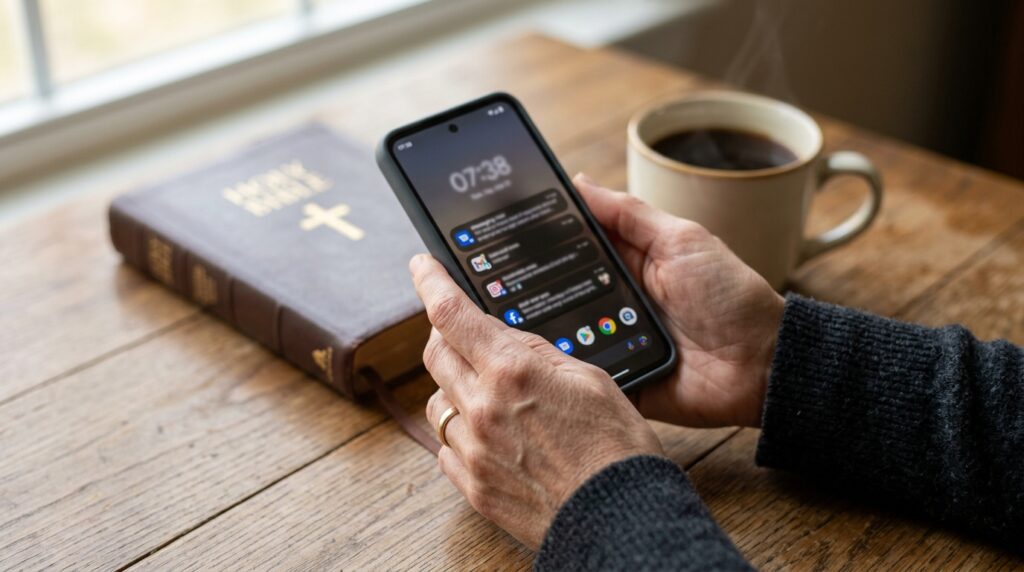
Redeeming the Time, One Habit at a Time
“Redeeming the time” in Ephesians 5:16 means rescuing our hours from being swallowed by what is empty and aligning them with God’s will. For adults with jobs, families, and responsibilities, this does not mean abandoning technology, but learning to use it in a way that supports, rather than sabotages, a life with God.
Small changes can have a large cumulative effect. Many Christian writers and ministries suggest simple practices like protecting the first minutes of the day from screens, silencing non‑essential notifications, and scheduling specific times to check email and messages instead of living in a constant state of partial attention.
- Begin each day with God’s voice before any other voice—Scripture and prayer before news and notifications.
- Choose fixed “check-in” windows for email and social media instead of reacting to every alert.
- Turn off push notifications for non-essential apps to cut the “digital leash.”
You do not have to fix everything at once. Start with one or two habits that feel both meaningful and realistic. As those become normal, you can adjust and add others. The goal is a pattern of digital use that leaves you more available to God and more present to the people in front of you.

Setting Boundaries That Protect Your Heart
Psalm 101:3 says, “I will not set before my eyes anything that is worthless.” In a world of personalized feeds, this requires deliberate boundaries. Our apps are designed to keep us scrolling, often by highlighting what triggers outrage, envy, or curiosity, not what is noble, pure, or praiseworthy.
For adults, wise boundaries include both time limits and content limits. Time limits help prevent endless, mindless scrolling. Content limits guard against exposure to what dulls our conscience or feeds sinful desires. This may involve using built-in screen time tools, content filters, or even removing certain apps altogether if they consistently pull your heart away from God.
- Set daily app limits for your most time-consuming platforms.
- Designate phone‑free spaces (for example, dining table, bedroom) and phone‑free times (for example, first 30 minutes after waking, last 30 minutes before sleep).
- Curate your feeds intentionally—unfollow accounts that stir envy, fear, or temptation; follow sources that point you toward Christ and truth.
Boundaries are not about fear of technology, but about love for God and neighbor. Self‑control with devices is one way adults can obey the call to “do all to the glory of God” (1 Corinthians 10:31), including what they watch, share, and dwell on.

Replacing Mindless Scrolling with Life-Giving Rhythms
Simply deleting apps or reducing screen time will not be enough if nothing fills the empty space. The old habit will quickly return. Many pastors and counselors note that healthy change involves replacement: we lay down one pattern so that we can pick up another that is better.
Ask yourself: What life-giving practices could take the place of some digital time? It might be unhurried Bible reading, a daily walk with no headphones, face‑to‑face conversation, handwritten prayer, journaling, or simply sitting quietly in God’s presence. These are not “extras”; they are ways to re‑train your soul to be still and attentive again.
- Trade one nightly scrolling session for a short Psalm and 10 minutes of silent prayer.
- Replace “doomscrolling” news with a single trusted update source, followed by intercessory prayer.
- Use some commute or waiting-room time for Scripture audio, Christ-centered podcasts, or intentional silence instead of endless refreshing.
Over time, these new rhythms can re‑soften a heart numbed by constant input. The Spirit often speaks in quiet, not in noise. Choosing to put your phone down so that you can lift your eyes up is a small act of faith that says, “Lord, I want to hear You more than I want to be entertained.”

BIBLE REFERENCES
Ephesians 5:15–16 (ESV); 1 Corinthians 6:12 (ESV); 1 Corinthians 10:31 (ESV); Galatians 5:22–23 (ESV); Psalm 101:3 (ESV)